Yah and Yahu are two Hebrew surrogate divine names of the great divine name, Yehowah. In this post, we’ll first look at their spelling and pronunciation and then at how these surrogates are used in the Hebrew Bible. Both of these names are used in an impressive number of Hebrew theophoric names and Yah is also used independently in the Hebrew Bible. As with Jehovah, the surrogate Jah — the Anglicized form of Yah — has also been censored in translations of the Hebrew Bible. With the exception of a single apparent leak in the King James Bible, editors have systematically replaced the name Jah with the mundane title “the LORD”. Clearly there is a force at work in the world trying to prevent us from learning the proper names of God! Next, we’ll examine how the name Yah was created. French historian and linguist Gérard Gertoux asserts that Yah is a contraction of Yehowah, a mechanism that was “sans doute” (without doubt) the template for the abbreviations later found in Greek New Testament manuscripts called nomina sacra. I have never read about this connection anywhere else. I find it fascinating and, in retrospect, very compelling. Finally, we’ll look at some archaeological evidence for the extra-biblical use of Yah and Yahu in Judea and Samaria.
While the divine name Yahu is not used alone in the Hebrew Bible, this does not mean that Yahu was less venerated than Yah among Hebrews. Gertoux shows that the divine name Yahu enjoyed a level of reverence approaching that of the esteemed great divine name Yehowah. But more on Yahu later, in the next post, as it has its own unique history. Here in this post we will focus more on Yah.
Spelling and Pronunciation
So let’s begin. The Hebrew spelling of Yah is yod–he (יה; or in Latin characters, YH). There is nothing controversial about the pronunciation of Yah. In the Hebrew Bible, Yah vowel-pointing looks like this:
יָהּ
The little T-shaped point below the yod is a qamats — it indicates that a letter A vowel sound (as in father) will connect the yod and he. And the mapiq, the little dot within the he, specifies that, because the he is located at the end of the word, it will take on the role of a consonant rather than a vowel (both vowel and consonant are a possibility with he because it is one of the Hebrew matres lectionis.) The effect of the mapiq here is very subtle to the point of being neglible. But to reflect the consonantal he, some dictionaries transliterate the name as Yahh (two letters H rather than one).
Curiously, when Yah is incorporated into theophoric names, it’s almost always pointed without the mapiq. For example, see Isaiah (יְשַׁעְיָה) and Elijah (אֵלִיָּה). Without mapiq, the he is a vowel and technically, enunciation of Yah in theophoric names ends with an –â instead of an –āh (the vowel pronunciation of the letter A is the same in both instances, despite different diacritics). I imagine that only native speakers of biblical Hebrew (i.e., no one alive today) could produce or detect the subtle difference made by the consonant H.
So again, in the Hebrew Bible, the divine name Yahu is only used in the context of theophoric names. It is spelled יהו (yod–he–waw; in Latin characters, YHW). As we will discuss in the next post, Yahu is formulated from the combination of Yah and the Hebrew male pronoun hu. Therefore, it is consistent that the qamats from Yah is carried forward into Yahu:
יָהוּ
In Yahu, there is a dot called a shureq placed behind the waw. The shureq indicates a long letter U vowel pronunciation for waw (as in tune and cruel). So from these pointings, Yahu pronunciation is essentially the familiar yahoo.
Note that yod–he–waw (YHW) is the spelling of both Yahu and Yeho (from Yehowah). Their different vocalization is specified through vowel-pointing:
יָהוּ Yahu
יְהוֹ Yeho
One can imagine that, without vowel-pointing, reading yod–he–waw would be confusing. For example, in biblical times, there was no vowel pointing. How would a reader of the Hebrew scrolls have known how to pronounce YHW without pointing? The location would be one key. We know from our study of the great divine name that Yehowah was reserved only for the beginning of Hebrew theophoric names, and thus YHW at the beginning of a theophoric name would always be pronounced yeho-. Conversely, when encountered at the end of a theophoric name, YHW pronunciation would always be –yahu.
Furthermore, as Gertoux points out, the Yeh– pronunciation of Hebrew words that begin YH- is a defining characteristic of Hebrew compared to other Semitic languages. For example, the adjective “Jewish” is spelled the same way in Hebrew and Arabic: in Hebrew, Yehudi is spelled yod–he–waw–dalet–he (יהודי), and in Arabic, yeh–heh–waw–dal–heh (يهودي). However, Hebrew Yehudi is pronounced Yahudiyun in Arabic:

Thus, hypothetical pronunciations of YHWH that begin Yah– (Yahweh, Yahuwah, etc.) rather than Yeh– are simply not Hebraic. In my next post, we’ll briefly focus on the difference between the Hebrew and Arabic pronunciations of Yahu.
Yah and Yahu in biblical Hebrew theophoric names
With the Hebrew spelling and pronunciation of Yah and Yahu now out of the way, let’s continue with a look at the use of these surrogate divine names in the Hebrew Bible. The most frequent occurrence of Yah and the only occurrence of Yahu is within the context of Hebrew theophoric names. I have linked these names, listed below, to their Strong’s Hebrew Dictionary entries at Bible Hub. I do this so that you can more easily investigate the names yourself, discover their meaning, and also so that you can begin to explore Hebrew more generally.
Hebrew theophoric names that use Yah
- Abiyyah
- Adoniyyah
- Uwriyah
- Azanyah
- Achazyah
- Achiyyah
- Eliyyah
- Amatsyah
- Amaryah
- Atsalyah
- Bedeyah
- Benayah
- Besodeyah
- Zkaryah
- Tobiyyah
- Yosiphyah
- Yoshibyah
- Yizziyyah
- Yezanyah
- Yizrachyah
- Yachzeyah
- Yechizqiyyah
- Yechiyyah
- Yekolyah
- Yekonyah
- Yaareshyah
- Yiphdeyah
- Yeqamyah
- Yiriyyah
- Yeriyyah
- Yirmeyah
- Yeshochayah
- Yishshiyyah
- Yishmayah
- Ysha’yah
- Kenanyah
- Moadyah
- Machseyah
- Mikayah
- Mlatyah
- Malkiyyah
- Maadyah
- Maazyah
- Maaseyah
- Meshelemyah
- Mattanyah
- Mattithyah
- Nedabyah
- Noadyah
- Nechemyah
- Nearyah
- Neriyyah
- Nethanyah
- Obadyah
- Adayah
- Uzziyyah
- Azaryah
- Amasyah
- Ananyah
- Anthothiyyah
- Asayah
- Athayah
- Athalyah
- Pedayah
- Pelatyah
- Pelayah
- Pelalyah
- Peqachyah
- Pethachyah
- Tsidqiyyah
- Tsephanyah
- Qolayah
- Reayah
- Rechabyah
- Ramyah
- Reelayah
- Raamyah
- Rephayah
- Shebanyah
- Shecharyah
- Shekanyah
- Shelemyah
- Shemayah
- Shemaryah
- Shearyah
- Shephatyah
- Sherebeyah
- Serayah
Hebrew theophoric names that use Yahu
Wow, pretty impressive lists! Clearly Yah and Yahu were extremely popular among the Hebrews. However, because of the subsequent Hellenization of most of these names, it isn’t so easy for us to pick out Nehemiah or the prophets Elijah, Isaiah, Jeremiah, Obadiah, Zechariah, and Zephaniah. But they’re all there. Yah and Yahu are only recognizable if you apply some knowledge of Hebrew onomastics. But most people, even Christians, remain unaware. Some of these names continue to be used today, millennia later. For example, how many men named Jeremy know that, hidden behind that letter Y at the end of their name is the name of their Creator, Yah?! Isaiah results from the combination of yasha and Yah, meaning “salvation of Yah”. That meaning should sound familiar to Christians. How did the Hebrews construct a similar theophoric name with yasha and Yehowah? And where did the name Jesus come from — is it a theophoric name? We’ll definitely address these related questions in a future post.
From these lists of Yah and Yahu theophoric names, what pattern jumps out at you? The obvious pattern is that, without exception, Yah and Yahu are used as a suffix. In fact, there are no Hebrew theophoric names in the Bible that begin with Yah or Yahu. Not a single case among all of these names! Let your mind marinate in that fact for a moment. If a Yah– prefix is biblically unprecedented in Hebrew theophoric names, proponents of a pronunciation of YHWH that begins Yah-, like Yahweh or Yahuwah, are unwittingly asserting that the most theophoric Hebrew name of all is constructed in a manner that is unprecedented among Hebrew theophoric names in the Bible.
The Hebrew people clearly reserved the beginning of theophoric names for the great divine name Yehowah rather than its shorter surrogates Yah and Yahu. Again, the biblical witnesses confirm this. There exists in the Hebrew Bible only Yehochanan; there is no Yahchanan or Yahuchanan. There is only Yehonathan; no Yahnathan or Yahunathan. Only Yehoshua; no Yahshua or Yahushua. And as shown in my previous post, the Greek transcriptions of Hebrew theophoric names in the Septuagint are also consistent with Yeho– prefixes. Further, there are no Hebrew theophoric names beginning YHW- that are transcribed Iα– (iota–alpha) or Iαω– (iota–alpha–omega) in the Septuagint. Not one single example. Thus, we can be confident that as far back as the 3rd century BC, at the time when the Septuagint was completed, the Hebrew pronunciation of YHWH did not begin Yah– or Yahu-.
A second pattern we can see from the above two lists is that many of the names in one list have a counterpart in the other list. For example, the name Abiyyah can be found in the other list as Abiyyahu. This pattern suggests that the –yah and –yahu suffixes are interchangeable. Is that true? We will not address this question here, but will postpone doing so until the next post, which will focus more exclusively on the divine name Yahu.
Halleluyah and other uses of Yah in the Hebrew Bible
Hands down, the most prevalent use of Yah in society today is in the context of the Hebrew loan word halleluyah. This word is technically a sentence, an imperative (command) meaning, in Old English, “praise ye Yah” which, in modern English, is roughly equivalent to “praise Yah everybody”. So by using this word, we are invoking the proper name of the God of Abraham and admonishing those within earshot to praise Him. As with Hebrew theophoric names, it is remarkable, but perhaps not coincidence, that halleluyah has been preserved over millennia in the lexicons of many languages. The Hebrew language itself even died during that time and lay dormant for centuries! And still these Hebrew names and words perdure to this day.
Sometimes we see halleluyah written without the beginning and ending letter H, and the letter Y is replaced with an I, producing the spelling alleluia. This is the Greek transcription of halleluyah. I think it’s instructive to understand what’s going on here. The Greek language doesn’t have a letter H equivalent. And so the Jewish translators of the Septuagint simply omitted the letter H. As for the letter Y, Greek iota is the Hebrew yod equivalent. As with the Hellenized theophoric names mentioned previously, I find alleluia to be an unfortunate transcription because the divine name is visually concealed. And when you multiply this concealment by the number of instances of halleluyah and Yah theophoric names in the Bible, unfortunate becomes too mild of an adjective.
Apart from theophoric names, Yah appears in the Hebrew Bible almost fifty times, either alone or within halleluyah and once, in Song of Solomon, within the word shalhebethyah (meaning, “a flame of Yah“). A few times it even makes an appearance alongside Yehowah in the same verse — so Yah is clearly a separate and independently recognized name of the God of Abraham. Here’s a summary of these occurrences, all linked to Hebrew text at Bible Hub:
- Exod 15:2 (Moses’ Song of Deliverance)
- Exod 17:16
- Psa 68:4
- Psa 68:18
- Psa 77:11
- Psa 89:8
- Psa 94:7
- Psa 94:12
- Psa 102:18
- Psa 104:35 (halleluyah)
- Psa 105:45 (halleluyah)
- Psa 106:48 (halleluyah)
- Psa 111:1 (halleluyah)
- Psa 112:1 (halleluyah)
- Psa 113:1 (halleluyah)
- Psa 113:9 (halleluyah)
- Psa 115:17 (halleluyah)
- Psa 115:18 (occurs twice, alone and in halleluyah)
- Psa 116:19 (halleluyah)
- Psa 117:2 (halleluyah)
- Psa 118:5 (occurs twice)
- Psa 118:14
- Psa 118:17
- Psa 118:18
- Psa 118:19
- Psa 122:4
- Psa 130:3
- Psa 135:1 (halleluyah)
- Psa 135:3 (halleluyah)
- Psa 135:4
- Psa 135:21 (halleluyah)
- Psa 146:1 (halleluyah)
- Psa 146:10 (halleluyah)
- Psa 147:1 (halleluyah)
- Psa 147:20 (halleluyah)
- Psa 148:1 (halleluyah)
- Psa 148:14 (halleluyah)
- Psa 149:1 (halleluyah)
- Psa 149:9 (halleluyah)
- Psa 150:1 (halleluyah)
- Psa 150:6 (occurs twice, alone and in halleluyah)
- Isa 12:2 (together with Yehowah; Song of Thanksgiving)
- Isa 26:4 (together with Yehowah; Song of Trust in God’s Protection)
- Isa 38:11 (occurs twice; Song of Thanksgiving)
- Song 8:6 (shalhebethyah)
So we see that the use of Yah was very early. Moses knew the name. He and the sons of Israel used this divine name in their ode to Yehowah after being delivered from the hands of the Egyptians. We also see a clear trend: Yah is used specifically in songs; even outside of Psalms, the use of Yah is almost completely restricted to songs. Couple this with its use as a suffix in many Hebrew child names and we can conclude that Yah is generally used in poetic contexts that are associated with joy and celebration. Thus, Yah is considered a name of affection. A pet name. A hypocorism. A diminutive.
As with Yehowah, replacement of the name Yah with the drab and less personal title “the LORD” is also prevalent in translations of the Hebrew Bible. Compare English translations of Isaiah 12:2, Isaiah 26:4 and Isaiah 38:11 at Bible Hub to get a feel for this censorship. To the credit of its translators, the King James Bible preserves Yah in one of the Psalms in a beautiful verse:
Psalms 68:4
“Sing unto God, sing praises to his name: extol him that rideth upon the heavens by his name JAH, and rejoice before him.”
Kings James Bible
Meanwhile, in the New American Standard Bible (1995), the use of Yah has been whittled down to only two mentions (twice within hallelujah) in the book of Revelation and of course its concealed within scores of Hellenized theophoric names. Therefore, as with Yehowah, we must be diligent and search outside of conventional sources to discover the surrogate Hebrew divine name, Yah.
The creation of Yah from YHWH
So what is the origin of Yah? Very few people ask this question. Lay Christians don’t ask because, due to its removal from their Bibles, they don’t know this divine name exists. Christian scholars don’t ask because they’re generally focused on the Greek Bible, where Yah never appears. For the Christians that have wondered about it, the majority assume that YH (Yah) is simply the beginning of the great divine name, YHWH. For example, I have personally heard the off-hand comment, “YH must be the beginning of YHWH”, as though it were self-evident. This insistence generally stems from proponents of a Yahweh or Yahuwah pronunciation of YHWH, pronunciations that — for reasons explained above — are neither Hebraic nor consistent with Hebrew onomastics. Thus, these proponents especially need YH to be the beginning of YHWH. Otherwise their case is hanging by a very thin thread.
Gérard Gertoux proposes that the yod and he of YH are the respective “first and the last, the beginning and the end” of the great divine name, YHWH. That is, from Yehowah came the diminutive Yah. Why hasn’t this possibility been discussed? Let’s be Bereans and explore it. I think that once you are made aware of some history regarding the abbreviation of sacred names, you’ll find Gertoux’s proposal to be quite compelling.
Using the beginning and the end of a word to make an abbreviation is called a contraction. Thus, Gertoux posits that Yah is a contraction of Yehowah. In contrast, a suspension is when only the beginning of a word is used to make an abbreviation. For example, Yahweh and Yahuwah proponents are essentially arguing that Yah is a suspension of their favored pronunciations. So which is it? Is Yah a contraction or a suspension? Perhaps there exists a historical witness of divine name abbreviation that can help us. Examine the following photos:



Photo descriptions: (1) Empress Zoe mosaic, Hagia Sophia, Istanbul; (2) stained glass, Immanuel Lutheran Church, Olivette, Missouri, USA; (3) mural in the church of the Troyan Monastery, near Troyan, Bulgaria.
What do we see here in these works of Christian religious art? These are contractions of the Greek ΧΡΙCΤΟC (Christos) and ΙΗCΟΥC (Iésous), the translation of the Hebrew Mashiach (Messiah) and the Hellenized version of Yeshua (Jesus), respectively. The contractions are written in majuscule. The Greek letter “C” is actually a lunate sigma — a special way of writing the letter S in koine Greek (usage of the lunate sigma can also be seen in the P46 papyrus sheet below that we’ll discuss in a moment). So this is all very interesting for us. Could the shortening of Yehowah to Yah be related to this practice of sacred name contraction? Let’s keep digging. The art photographed above seems relatively recent. Where else and how far back were such contractions used? And what about Greek equivalents of “Lord” and “God” — were they also contracted? To address these questions, let’s turn to an excerpt from the book Encountering the Manuscripts (2005) by New Testament scholar, Philip Comfort:
A phenomenon occurred when the books of the New Testament were written, published and distributed in the first century. Either the writers themselves or the very earliest copyists used a special written form for the divine names. Instead of writing out in full (in plene) the Greek words for kurios (Lord), Iēsous (Jesus), Christos (Christ), theos (God), and pneuma (Spirit), the writers and/or scribes wrote these words in special abbreviated (or contracted) forms. Today very few know about this, even those who read the Greek New Testament, because the nomina sacra (sacred names) are not replicated in any fashion in printed editions of the Greek New Testament.
Encountering the Manuscripts: Chapter 4, The Nomina Sacra in New Testament Manuscripts, p. 406.
Comfort answers most of our questions in this excerpt. To confirm his last point, about the failure of printed Greek texts to perpetuate the nomina sacra found in the earliest hand-written copies, compare the Greek-English interlinear text of Bible Hub with a copy of a letter from Paul to the Corinthians in Papyrus 46, one of the earliest existing copies:
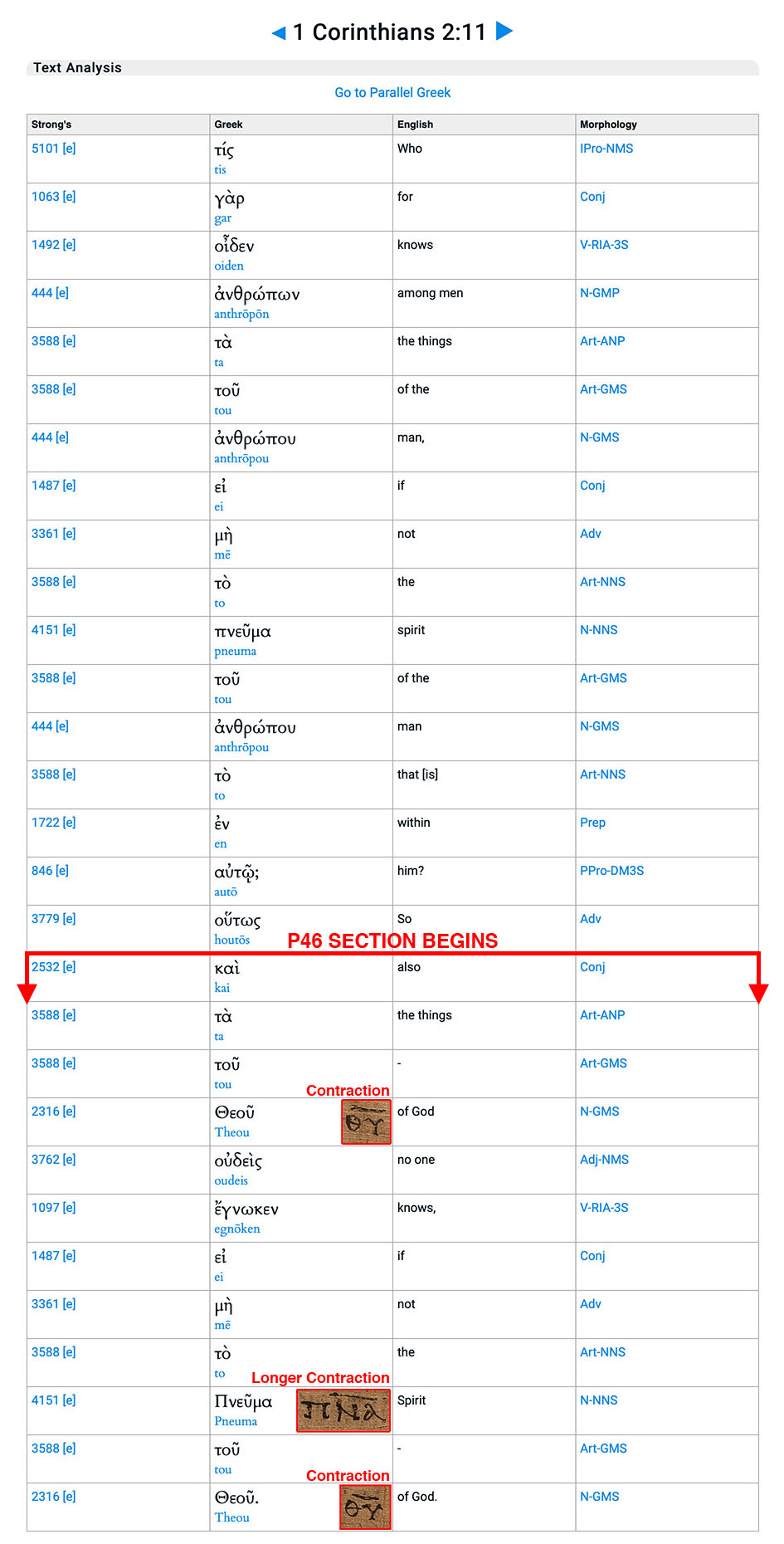

The papyrus text begins in the middle of verse 11 in the second chapter of 1 Corinthians, marked “P46 SECTION BEGINS” in the screen capture from Bible Hub. We see that the interlinear Bible displays God as Θεοῦ (Theou), and Spirit as Πνεῦμα (Pneuma), without contraction and without any indication to readers that these words existed long ago — perhaps even originally — as nomina sacra. I have inserted, into the Bible Hub screen capture, the corresponding nomina sacra from the papyrus: two contractions of God (ΘΥ, theta-upsilon) and one of Spirit (ΠΝΑ, pi-nu-alpha). So Comfort indeed seems to be onto something. Without the enduring Christian art that contains them, how would anyone today still know about the nomina sacra?
The list of all the names and words that were eventually deemed sacred by Christendom and contracted over the next few centuries became quite long. We won’t cover them all. What’s important for this post is that Comfort addresses our initial questions in the above excerpt from his book. The nomina sacra contractions were used very early, perhaps as early as the first century. Contractions of the name Jesus and Christ, along with the Greek equivalents of God, Lord and Spirit can be found in almost all of the earliest existing New Testament papyri. Thus, these five words are generally considered to represent the early consensus group of nomina sacra. In summary, these nomina sacra took the following majuscule forms, all with a horizontal stroke over them (which I am unable to reproduce here in the blog text):
- God: ΘC from ΘΕΟC (Theos)
- Lord: ΚC from ΚΥΡΙΟC (Kurios)
- Jesus: ΙC, ΙΗC or ΙΗ* from ΙΗCΟΥC (Iésous)
- Christ: ΧC, ΧΡC or ΧΡ* from ΧΡΙCΤΟC (Christos)
- Spirit: ΠΝΑ from ΠΝΕΥΜΑ (Pneuma)
* The IH and XP suspensions are also found in early manuscripts, but soon yielded to the indicated contracted or longer contracted forms; longer contractions include additional letters, in addition to the first and last, presumably in order to distinguish the contractions from other known contractions or words.
The nomina sacra listed above correspond to only the nominative cases of these words — some have genitive case counterparts as well. For example, in addition to the nominative ΘC, there is also a genitive ΘΥ (from ΘΕΟΥ [Theou]), which we just saw used a few times in the P46 papyrus sheet above.
In his book, Comfort devotes a large section of his chapter on the nomina sacra to their origin. Does he, like Gertoux, make the connection between the contraction of Hebrew YHWH to YH and the contraction of Greek ΘΕΟC to ΘC or ΚΥΡΙΟC to KC? The short answer is: No. And neither do almost all other nomina sacra scholars that I have come across in my searches: not Ludwig Traube (German article), not Anton Paap, not Colin Roberts, not George Howard and not Larry Hurtado. I could find only one scholar — Mathias Delcor (French) — allude to a link between the nomina sacra and the abbreviation of YHWH:
On sait enfin que les premières abréviations que l’on trouve dans les grands onciaux concernent une dizaine de nomina sacra. Et l’on tient généralement que l’usage de les abréger dans les manuscrits de la LXX, qui selon la thèse de Paul Kahle ont tous été écrits par des chrétiens, est imité de l’abréviation du tétragrammaton. D’ailleurs, on trouve déjà dans les papyri Chester Beatty de la Bible grecque datant du iie siècle après J.-C., les formes Κς, Kυ, θς, θυ, etc., pour Κύριος, Κύριου, θεός, θεόυ, etc.; de même dans les papyri de la LXX des petits prophètes de la collection Freer datant du iiie siècle après J.-C.. Et on peut suivre dans l’ouvrage de L. Traube toute l’évolution des nomina sacra.
Translation: Finally, we know that the first abbreviations found in the major uncials concern about ten nomina sacra. And it is generally held that the use of abbreviating them in the manuscripts of the LXX, which according to Paul Kahle’s thesis were all written by Christians, is imitated from the abbreviation of the Tetragrammaton. Moreover, we already find in the Chester Beatty papyri of the Greek Bible dating from the 2nd century AD, the forms Κς, Kυ, θς, θυ, etc., for Κύριος, Κύριου, θεός, θεόυ, etc.; the same is true in the papyri of the LXX of the minor prophets in the Freer collection dating from the 3rd century AD. And one can follow in the work of L. Traube the whole evolution of the nomina sacra.
Des diverses manières d’écrire le tétragramme sacré dans les anciens documents hébraïques (1955) Revue de l’histoire des religions, Vol. 147, p. 159.
So it was apparently conventional wisdom, at least among Delcor and his colleagues, that the nomina sacra were imitating the “abbreviation” of the Tetragrammaton. However, apart from Gertoux (over forty years later), this is the only instance that I am aware of in which someone states it explicitly. But notice that Delcor avoids being more precise. The examples of the nomina sacra that he provides — ΚC, ΚΥ, ΘC, ΘΥ — are all contractions. What was holding him back from taking the next logical step and asserting that the nomina sacra were imitating the contraction of the Tetragrammaton?
He was inhibited by logic.
Delcor believed YHWH was pronounced Yahweh! And he knew that only a suspension of Yahweh would produce Yah. Thus, because of this incongruence, he chose to use the more general term abbreviation and hoped that nobody would notice. Had he instead opened this can of worms and discussed this incongruence in his article, he would have had to admit that the unsophisticated position of laymen, that YHWH is pronounced Yehowah (Jehovah), is actually perfectly consistent with the origin of the nomina sacra.
As we’ll see, Comfort and those before him clearly believe that the Tetragrammaton was an inspiration for the origin of the nomina sacra. But unlike Delcor, they never associate the nomina sacra with the short surrogate divine name Yah. Despite devoting an entire chapter of his book to the exploration of sacred name abbreviations, Comfort never even mentions Yah, the oldest enduring sacred name abbreviation. So just as very few people know that the earliest Greek manuscripts used nomina sacra, even fewer — apparently not even Comfort himself — know that the Hebrew name Yah is an abbreviation of Yehowah. Therefore, in my view, Gertoux has corrected a particularly acute case of myopia.
Comfort promotes the theory first proposed by Ludwig Traube, that the nomina sacra are the result of a Christian practice that was adopted from Jewish tradition. In Hebrew and Greek texts of Scripture, Jewish scribes visually set apart the Tetragrammaton from surrounding text by gilding it. Alternatively, they wrote the great divine name in paleo-Hebrew script rather than Assyrian square script or Greek (𐤉𐤄𐤅𐤄 instead of יהוה or ΚΥΡΙΟC). By consistently setting apart the Tetragrammaton in these ways, they venerated the divine name. Thus, Traube argues that Jewish Christian contemporaries of the aforementioned group of scribes were motivated to develop a new way of setting apart references to Yehowah and Yeshua in Christian works, and from this effort the nomina sacra were born. This seems like a reasonable theory, given no other information. But we now know that an abbreviation of the Tetragrammaton had long existed in Hebrew in the form of the diminutive, Yah. Traube and other nomina sacra scholars never mention this pertinent fact. And so in this light, Traube’s theory seems incomplete. Evidently blind to the name, Yah, Traube and subsequent promoters of his theory haven’t quite been able to thread the needle like Gertoux has.
Given the context surrounding the origin of the nomina sacra, coupled with our understanding of Hebrew onomastics, the case for YH being a contraction of YHWH is very strong. The narrative that can best harmonize all these factors goes something like this: Early Christian authors and scribes, many of them Jewish, were well-aware of the Hebrew divine name Yah and its linguistic derivation from Yehowah, and they applied this knowledge in their creation of the original Greek nomina sacra. I will call this the Gertoux Theory of Sacred Name Contraction. If we imagine the family tree of sacred name abbreviations, Yah would be the trunk, and the Greek nomina sacra would later branch from it.

This relationship between the Hebrew and Greek construction of sacred names seems intuitive and, in retrospect, obvious. Note, however, the inversion of veneration. In the Hebrew Bible, Yah is used in a relatively less solemn manner compared to the great divine name, Yehowah. But in the nomina sacra system, contraction was used to indicate sacral use, whereas the full version indicated profane use. And by sacral and profane, I mean in the same way that English Bible publishers use an upper-case and lower-case letter G to differentiate God (sacral) and god (profane).
Philip Comfort makes a puzzling final comment regarding the possible novelty of the nomina sacra:
In conclusion, it must be noted that though inspired by the Tetragrammaton, the written form of the Christian nomen sacrum for “Lord” was a unique creation. Nowhere did the Jews use an overbar for the sacred name. And in no way did the Christian writers simply imitate the consonantal form of YHWH; otherwise, they would have written ΚΡC. However, not one early Greek manuscript has the name written in this way; all manuscripts exhibit the two-letter KC.
Encountering the Manuscripts: Chapter 4, The Nomina Sacra in New Testament Manuscripts, p. 434.
The consonantal form of YHWH was not imitated? Hmm. But Hebrew doesn’t have vowel characters like Greek. YHWH is simply how one spells the name of God in biblical Hebrew. Just as Jerusalem is spelled YRWSLM. And David is DWD. Semitic languages like Hebrew use an abjad script — the reader must mentally provide the vowel used to vocalize the consonants. Thus, “consonantal form” was never used in order to revere the divine name YHWH — consonantal form is inherent to Hebrew. Even “satan” is written in consonantal form; it is the epitome of profane. Many of the earliest Christian scribes were Jews who knew Hebrew. Thus, they would never have considered removing the vowels of ΚΥΡΙΟC in order to indicate sacredness. Yes, the nomina sacra are peculiar to early Christendom and they were likely inspired by Jewish reverence of the Tetragrammaton. But it doesn’t follow that Greek sacred name contractions were therefore unique. Gérard Gertoux is straightforward about this in his book, Un Historique du Nom Divin (1999):
Cette façon de remplacer un nom sacré par une abréviation a sans doute été inspirée par la coutume juive de remplacer le nom sacré YhwH par son substitut YH.
Translation: This way of replacing a sacred name with an abbreviation is undoubtedly inspired by the Jewish custom of replacing the sacred name YhwH with its substitute YH.
Un Historique du Nom Divin: Chapter 2, Historique: De Justin à Jérôme [150–400 AD], p. 113.
Archaeological Evidence of Yah and Yahu
As Ludwig Traube was preparing his manuscript in Munich on the nomina sacra, his German compatriot Ernst Sellin, an archaeologist and Old Testament scholar, was planning trips to Jericho to see what biblical era artifacts his team could find there. Sellin eventually reported on the excavations that he led during the spring seasons of 1908 and 1909. The report of his 1909 excavation (German) includes the following two images, with figure legends that contain words that should now be familiar to you, even if you don’t know German:

Jah and Jahu are the German localizations of Yah and Yahu! In the paragraph above the two images, in the first sentence of the text, you can also see that יה and יהו are being discussed. In the context of Sellin’s report, a Krug is a clay jar or jug and Stempel are stamped impressions. Thus, Krugstempel are jar stamps. Sellin is reporting the identification of jar handles stamped with Yah and Yahu. We can imagine this was quite an exciting discovery! In his 1908 report (German), venturing an explanation for this practice, Sellin points to the writing of the prophet Zechariah (14:20–21): “Indeed, every pot in Jerusalem and Judah will be holy to Jehovah of Hosts.” This ancient practice of placing the divine names on jar handles is confirmed in text of the Babylonian Talmud (c. 450-550 BC): “If one of the names of God was written on the handles of vessels or on legs of a bed, one must cut off the name and inter it” (B. Arakhin 6a:9, referring to B. Shabbat 61b:7).
In total, excavations in Palestine by Sellin and others have produced over 170 Yah and nearly 100 Yahu jar stamp handles! All of these jar handles have been dated to the 3rd and 4th centuries BC, meaning well after the exile of the Jews from Babylon. These short divine name surrogates are written in a somewhat Aramaicized paleo-Hebrew script, which is itself very similar to Phoenician script: 𐤉𐤄 (YH) and 𐤉𐤄𐤅 (YHW). Why the Aramaic influence?
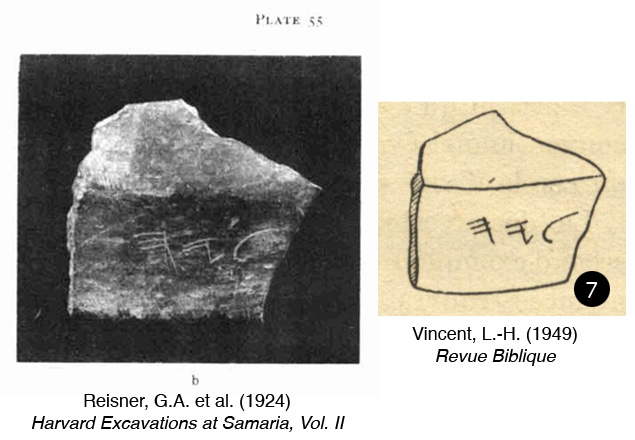
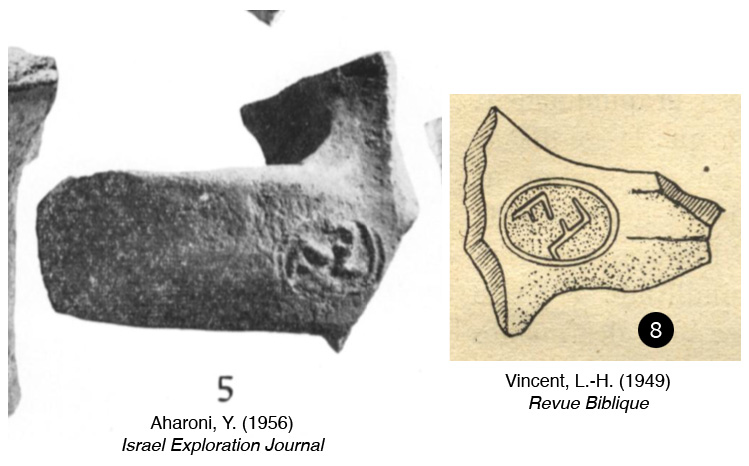
In post-exile Judea, which was initially a province of the Achaemenid (Persian) empire, Aramaic became an important language, as it was the lingua franca of the empire. Attesting to this, parts of the writings of the prophets Ezra and Daniel, for example, were originally written in Aramaic. Post-Achaemenid empire, regional variations of Aramaic eventually emerged throughout its former territories. In Judea, Hasmonean Aramaic became the official administrative language. Hebrew was still taught and used for religious purposes. However, a new Aramaic-inspired script was developed for Hebrew called Assyrian or square script, which is still used in modern Hebrew. In post-exile jar handle stamps, paleo-Hebrew was used out of nostalgia — Yah and Yahu were references to the Hebrew God. But after generations of speaking and writing Aramaic, paleo-Hebrew script drifted somewhat under its influence. The affect of Aramaic on certain paleo-Hebrew letters is clear. For example, from the images below, compare how Yah appears in the pre-exile period inscription of No. 7 to the post-exile jar stamp of No. 8; the paleo-Hebrew letter he, originally similar to the Phoenician 𐤄, changes towards the direction of the Imperial Aramaic 𐡄.
The four images below consist of published pottery inscriptions and two additional jar stamps. To help interpret these inscriptions and stamp impressions, I’ve coupled their images with line drawings made by French archaeologist Louis-Hugues Vincent from his 1949 review (French) on Judean epigraphy. Below these images is a summary based on translations made by Gérard Gertoux.


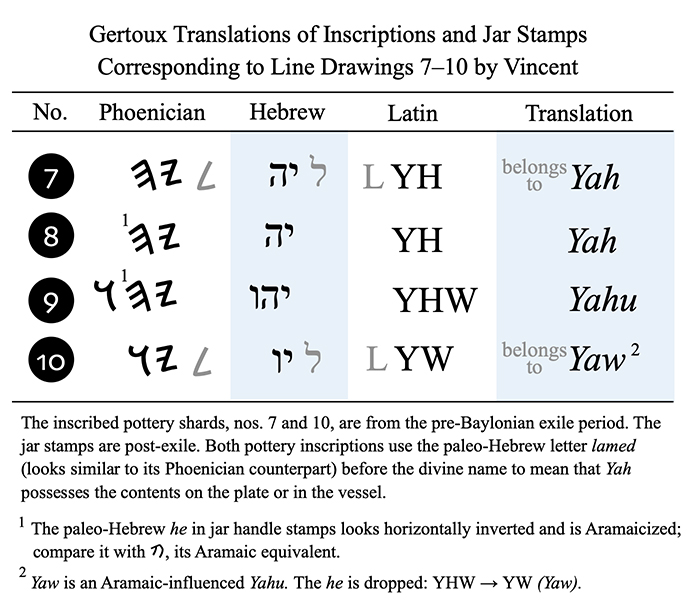
Gertoux also notes that the use of lamed before the divine name can be found in the Hebrew Bible and that from this usage we can derive its meaning. For example, in Isaiah 44:5 we find L YHWH (ליהוה) used a few times:
זה יאמר ליהוה אני וזה יקרא בשם־יעקב וזה יכתב ידו ליהוה ובשם ישראל יכנה׃ פ
Translation: “This one will say, ‘I am Jehovah’s‘; And that one will call on the name of Jacob; And another will write on his hand, ‘Belonging to Jehovah,’ And will name Israel’s name with honor.”
Top: Westminster Leningrad Codex. Bottom: New American Standard Bible (1995).
Thus, the dish inscribed with L YH (No. 7, from Reisner, G.A. et al., 1924) and the jar inscribed with L YW (No. 10, from May, H.G., 1933) were perhaps used as receptacles for tithes or offerings. Vincent suggests that these inscriptions contain lamed because they originate from outside Judean territory: No. 7 was found in Samaria and No. 10 in Megiddo. Unlike Judea, where the God of Israel was the sovereign authority, in surrounding territories others gods were worshipped. Thus, Vincent argues that the lamed was necessary in these instances to clarify the purpose of pottery with divine name inscriptions or stamps. Within Judea however, it was a foregone conclusion what the presence of YH or YHW meant — a lamed was superfluous.
However, the lamed was used in jar handle stamps in pre-exile Judea, that is, in the Kingdom of Judah. But rather than being used with YH and YHW, the lamed was prefixed to MLK (melek), meaning “king”. Thus, putting it all together, LMLK means “belonging to the king”. The LMLK jar handles are quite famous. For those interested, I recommend perusing the website of specialist and collector George Grena, who has studied them quite rigorously: The LMLK Research Website.
According to Grena, a specific storage jar was always used for LMLK stamps: “Type 484”. Unfortunately, I was unable to find out for this post whether YH and YHW stamps were restricted to one type of jar. Below is a photo and cross-section of the LMLK jar type (published by Paul Jacobs in 2001); the jar is a little over two feet high. If filled with a liquid, like oil or wine, Grena estimates that the jar would have weighed over 50 pounds.
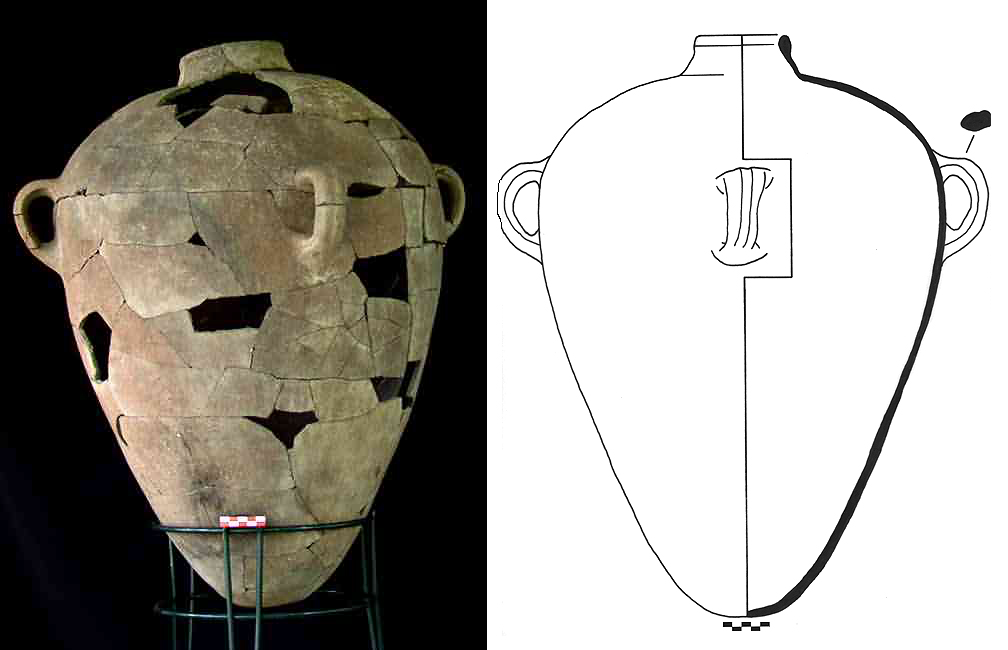
The LMLK stamps per se are outside the scope of this post. But I mention them here because they are evidence that stamping jar handles was not an isolated post-exile Judean phenomenon. As Vincent proposes, it is easily conceivable that the YH and YHW jar stamps represent a continuation of a practice that occurred pre-exile in the Kingdom of Judah.
(A quick aside: while using the internet to learn more about jar stamps, I stumbled upon an old University of Pennsylvania Museum of Archaeology and Anthropology website called Canaan and Ancient Israel. For a lay person like me, I found it to be a good and concise basic introduction to archaeology and ancient Near Eastern culture.)
In the above table of Gertoux’s translations of pottery epigraphy, I note that Yaw (YW) was an Aramaicized version of YHW: the letter H of YHW is removed to give YW. Gertoux further explains that this change in spelling arose because the letter H was barely audible. YHW (Yahu, pronounced yahoo) and YW (Yaw, pronounced ya-oo) were practically phonetic equivalents. We know that Jews venerated YW as a divine name, along with YH, because of its censorship from, of all places, Hebrew numerals.
Both YH (יה) and YW (יו), according to the Hebrew numbering system (which was adapted from the Greek), should represent numbers 15 and 16, respectively. At least theoretically. Here are numbers 1–20:
- א alef
- ב bet
- ג gimel
- ד dalet
- ה he
- ו waw
- ז zayin
- ח het
- ט tet
- י yod
- יא
- יב
- יג
- יד
- יה ten + five
- יו ten + six
- יז
- יח
- יט
- ך kaf
However, in practice, numbers 15 (yod + he) and 16 (yod + waw) have been replaced:
- א
- ב
- ג
- ד
- ה
- ו waw
- ז zayin
- ח
- ט tet
- י
- יא
- יב
- יג
- יד
- טו nine + six
- טז nine + seven
- יז
- יח
- יט
- ך
According to Wikipedia, the tet-waw and tet-zayin combinations are used for 15 and 16, respectively, to refrain from using the alternative forms of the divine name (YH and YW) in everyday writing. No source is provided, unfortunately; apparently this is conventional wisdom among Jews. The point being, this practice confirms that YH and YW continue to be perceived by Jews as divine names.
Gertoux reports that this Hebrew numbering system began in the 4th century BC, under influence of the Greek empire. According to archaeologist Joseph Naveh, the earliest known use of this number system was on a coin struck in 83 BC. However, despite scouring the internet, I could not find whether this replacement of the short divine names was implemented initially or is a more recent phenomenon. It would not surprise me if the names were replaced from the outset because the Jews were passionate when it came to the names of God.
As mentioned above, the Babylonian Talmud emphasizes that the utmost attention must be placed on the care of the written names of God. We can also see in the Greek Septuagint (c. 280 BC), the spilling over of this divine name obsession into the translation of Leviticus 24:15-16. Compare these Septuagint- and Masoretic-based versions:
“And speak to the sons of Israel, and thou shalt say to them, Whosoever shall curse God shall bear his sin. And he that names the name of the Lord, let him die the death: let all the congregation of Israel stone him with stones; whether he be a stranger or a native, let him die for naming the name of the Lord.”
Brenton Septuagint Translation
“You shall speak to the sons of Israel, saying, ‘If anyone curses his God, then he will bear his sin. Moreover, the one who blasphemes the name of Jehovah must be put to death; all the congregation shall certainly stone him. The stranger as well as the native, when he blasphemes the Name, shall be put to death.”
New American Standard Bible (1995)
The Jewish translators behind the Septuagint really turned it up a notch. Blaspheming the name of Jehovah became equivalent to naming Jehovah. Merely saying the name of God became a capital crime — an offense worse than cursing God! Thus, in the Septuagint we find early evidence of the “ineffable name” movement. And two thousand years later, we have global censorship of the names of God (Yah, Yehowah, and arguably, even Yahu) from our Bibles. Were it not for the Karaites, the Lutherans of Judaism likely responsible for the Hebrew Bible (Masoretic Text), the divine names YHWH and YH might still be hidden from us today.
So one final thing about jar stamps. (Brace yourselves for some cognitive dissonance). The academic gatekeepers in archaeology today no longer read the YH and YHW jar stamps as Yah and Yahu. Instead, they insist that both YH and YHW are to be read YHD, as in Yehud (the Aramaic of Yehudah). Seriously. I am not joking. This is really what they are teaching, and have been for decades. They have written a creative narrative around this Yehud interpretation that they apparently believe is more compelling than the initial parsimonous Yah and Yahu readings of Ernst Sellin. Vincent, Delcor and Gertoux have pushed back on this with valid criticisms, but to no avail. My thinking: Over 170 jar handles stamped YH have been recovered. The Talmud mentions handles of vessels with divine names. YH is in the Hebrew Bible referring only to Yehowah, yet we’re to believe that Judeans used YH on jar handles as an abbreviation for Yehud? And this, after all we know about the preoccupation of Jews regarding the names of God. The Jews won’t even let a Hebrew numeral be confused with YH! So this Yehud narrative just beggars belief. If you’re interested in this academic drama, please see the criticisms of Vincent, Delcor and, of course, Gertoux, from whose writing my own opinions have been formed on this matter. So now it is time to recap and finish off this post.
Summary
In this post, we’ve looked at the simple spelling and very non-controversial pronunciation of the divine names Yah and Yahu. We’ve seen that these names are used — without exception, as suffixes — in many Hebrew child names that are mentioned in the Hebrew Bible. Several of these names endure to this day all over the world in various localized forms. We see that the popular exclamation halleluyah is the most prevalent source of Yah in society today. In the context of halleluyah, Yah is mentioned in the Hebrew Bible around a few dozen times. Alone, Yah is used yet another few dozen times. Either way, Yah is used in the Bible in the context of songs of praise. Whether it was used in a child name or in a song, Yah was generally reserved for use in less formal and celebratory occasions. We looked at an intriguing proposal from Gérard Gertoux, who describes how the diminutive Yah is mostly likely a contraction of the great divine name Yehowah. This contraction best explains the origin of the Greek nomina sacra, which are also contractions of names and words held in reverence among early Christians. Finally, we saw some archaeological evidence of the use of Yah and Yahu in Judea and Samaria and identified examples of how these short divine names were venerated and continue to be venerated by Jews.
Up Next
In my next post, I will try to distill the research of Gérard Gertoux on the divine name Yahu. Evidence of the use of Yahu, outside of theophoric names, is largely extra-biblical. So we will look at various artifacts, dated to both before and after the birth of Christ. We will review its pronunciation outside Jerusalem, especially in Greek and Arabic, languages used by the Jewish diaspora. As Gertoux explains in his research, Yahu was extremely venerated and eventually used in the context of superstitious practices.


In your blog about yah you mentioned a follow-up blog about yahu. Where can I find this, please?
Michael Veysey
You did a lot of work producing this article.
Now my work begins — reading it.